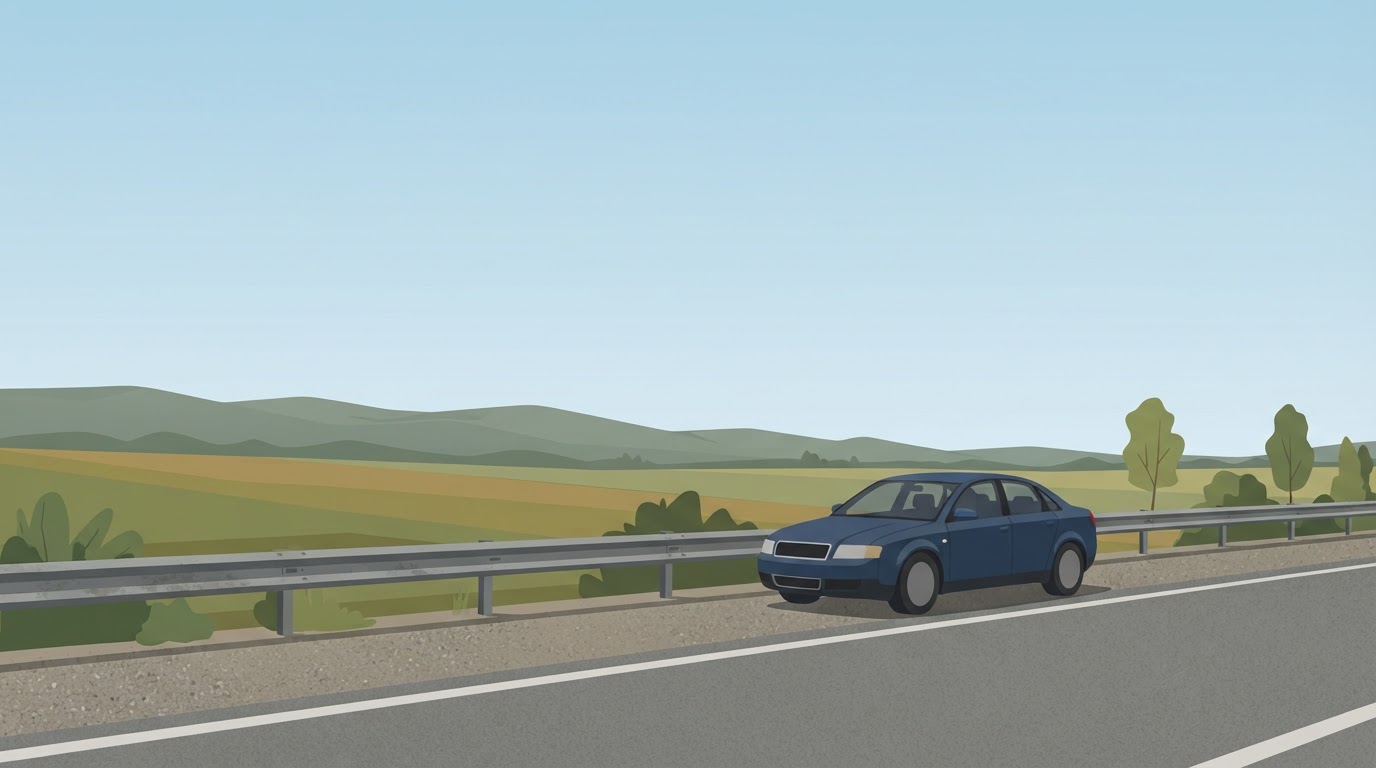
A single-car accident feels simpler than a multi-vehicle collision because there’s no other driver to argue with about fault. But that simplicity is deceptive. When you’re the only party involved, your insurer has no other statement, no other police report from a second party, and no other insurance company to cross-check your version of events against. Everything they know about what happened comes from you, your documentation, and whatever physical evidence you managed to capture before the scene changed. That puts the entire burden of building a credible record on your shoulders, and it starts before you ever pick up the phone.
What Counts as a Reportable Single-Car Incident
Not every bump or scrape needs to become a claim, but you should understand the range of events that fall into this category so you don’t dismiss something that actually matters. Single-car incidents typically include:
- Hitting a stationary object — a guardrail, a light pole, a fence, a parked car, a mailbox, a tree.
- Running off the road due to weather, road conditions, or a swerve to avoid an animal or debris.
- Hitting an animal, commonly deer, which many policies treat differently than a standard collision.
- Rolling or sliding in a ditch, on ice, or on gravel without contact from another vehicle.
- Damage from something falling onto the car — a tree limb, hail, debris from a storm.
- Fire or mechanical failure that leads to a loss of control or damage while driving.
Some of these are collision claims and some are comprehensive claims, and the distinction matters for how your policy responds. Hitting a deer, for example, is usually processed as comprehensive rather than collision on most policies, which can mean a different deductible applies. A tree branch falling on your parked car is comprehensive. Running off the road because you swerved is generally collision. If you’re not sure which category your situation falls into, that’s a fair question to ask when you call your insurer — don’t guess and don’t assume the terminology doesn’t matter, because it can affect what you owe out of pocket.
Even minor single-car incidents are worth documenting the same way you’d document a bigger one. A curb strike that seems cosmetic today can reveal itself as suspension damage a week later, and if you didn’t note the time, location, and circumstances when it happened, you’ll be reconstructing the story from memory instead of from a record.
Documenting the Scene Without Another Driver Involved
In a two-car accident, you exchange information and each party has some incentive to keep the account roughly accurate because the other person is standing right there. In a single-car accident, there’s no built-in check on your account except what you capture yourself. Treat the first few minutes after the incident as a documentation window, not just a safety check.
If you are safe to do so — meaning you’re not blocking traffic, you’re not on a live shoulder in poor visibility, and you’re not injured in a way that requires you to stay still — do the following before you move the vehicle or leave the location:
- Photograph everything, from multiple angles. Get wide shots that show the vehicle’s position relative to the road, the object you hit, and any skid marks or debris field. Then get close-up shots of the specific damage. Photograph all four sides of the car even if damage is only on one side, because it establishes a “before” reference for anything else an adjuster might question later.
- Photograph the object you hit or the terrain that caused the loss of control. A damaged guardrail, a pothole, a patch of black ice, a downed branch — capture it as it existed at the time, because road crews, property owners, or weather will erase this evidence quickly.
- Note the exact location. Use your phone’s GPS or drop a pin. If you know the mile marker, cross street, or a nearby landmark, write it down. “Somewhere on the highway” is not something you’ll be able to reconstruct accurately a few days later when the adjuster asks.
- Note the time. Not just “afternoon” — the actual time you left, the approximate time of impact, and the time you called for help or called your insurer. This matters for cross-referencing weather data and traffic conditions later.
- If a witness happened to see it — a passing driver, someone from a nearby house or business — ask for a name and phone number. Single-car incidents rarely have witnesses, but if one exists, that person’s account is one of the few pieces of independent corroboration you’ll have.
- Call for a police report if the damage is significant, if the vehicle is undrivable, or if there’s any possibility of injury. Even in a one-car incident, an officer’s report creates a neutral, timestamped record of the scene, the conditions, and your statement while everything is fresh. Many insurers ask for a police report or an incident number as a matter of course when there’s meaningful damage, so it’s worth requesting even when you’re not required to.
If you’re not able to safely stop and document — for example, you’re on a narrow shoulder with no safe place to pull further off — move the car to the nearest safe location first and document from there, noting that the original point of impact was elsewhere. Safety takes priority over the photo, but don’t skip the photo once you’re safe.
What to Note About the Road, Weather, and Vehicle
Once the immediate scene is documented, turn your attention to the surrounding conditions. These details often explain why the incident happened, and an insurer reviewing a single-car claim will want context, not just a description of the damage.
Road conditions
Write down what the surface was like at the moment of the incident: wet, icy, covered in loose gravel, recently repaved, potholed, poorly marked, unlit. If there was a specific defect — a sudden dip, a missing section of guardrail, a malfunctioning traffic signal — describe it clearly and photograph it. If a road hazard was the direct cause, some jurisdictions or agencies have a process for reporting hazardous road conditions separately from your insurance claim; noting the road’s condition thoroughly now means you have that option available later even if you don’t pursue it immediately.
Weather conditions
Record what the weather was doing at the time — rain, snow, fog, glare from low sun, high wind. If you can, note the approximate temperature, since that can be relevant to whether ice was a factor. You don’t need to be precise to the degree; “it had been raining steadily for about an hour” or “the sun was low and directly in my eyes” is exactly the kind of detail an adjuster finds useful, because it can be checked against historical weather records for that location and time.
Vehicle condition and behavior
Think through what the car was doing in the moments leading up to the incident. Did a tire blow out? Did the brakes feel unresponsive? Did the steering pull to one side? Was there a warning light on the dashboard beforehand? This matters for two reasons. First, it helps establish whether the cause was a road or weather event versus a mechanical failure, which can affect how the claim is categorized. Second, if a mechanical issue was involved, your insurer may want to know whether it was a sudden and unexpected failure or something you’d already noticed and delayed addressing, since that can factor into how the claim is evaluated.
Also note the vehicle’s mileage at the time, whether it was due for any maintenance, and whether you had any recent service done that could be relevant — new tires, a recent alignment, a recent repair to the same area now damaged again.
Reporting It to Your Insurer Accurately
When you’re ready to call, treat the report as a factual narrative, not an explanation or a defense of your driving. Stick to what happened, in order, without guessing at causes you’re not sure about and without minimizing details you think might make you look bad. If you’re not certain why the car went off the road, say that you’re not certain rather than offering a guess as established fact. Insurers deal with unclear causes constantly, and an honest “I’m not sure exactly why the back end slid, but the road was wet and I was going roughly the speed limit” is more useful and more credible than a confident explanation you’re not actually sure about.
Have the following ready before you dial:
- Your policy number.
- The exact date, time, and location.
- A police report number, if one was generated.
- Your photos and any witness contact information.
- A short, chronological account: where you were coming from, what you were doing, what happened, and what you did immediately after.
- The vehicle’s current location — whether it’s drivable, at your home, or already at a tow yard or repair shop.
Expect the representative or claims adjuster to ask clarifying questions about the road and weather conditions you documented, so have those notes in front of you rather than trying to recall them from memory. They may also ask whether you want to file the claim under collision or comprehensive coverage, depending on the cause — this is a good moment to ask how each option affects your deductible and how a claim of this type might affect your policy going forward, since that can vary by insurer and by your specific policy terms.
Finally, ask what happens next: whether an adjuster will need to inspect the vehicle in person, whether you need to get repair estimates on your own or use a shop from an approved network, and what the expected timeline looks like. Write down the claim number and the name of whoever you spoke with. A single-car accident leaves you as the sole narrator of the story — the more precise and complete that record is from the very first hour, the smoother every step after the phone call tends to go.