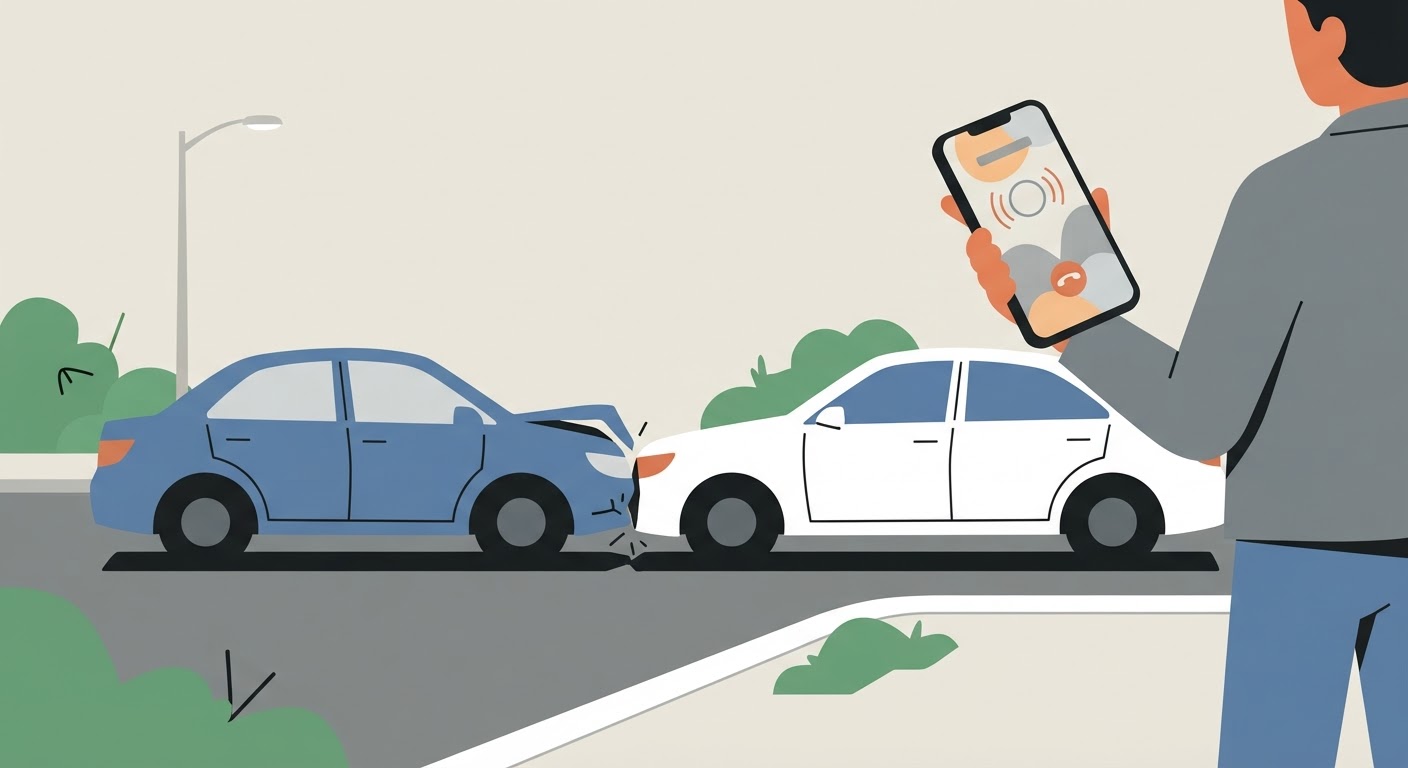
When to Call Versus When to File Online
Most insurers now offer at least three ways to start a claim: a phone call to a claims line, a mobile app submission, or a web form. Which one you use should depend on the situation on the road, not on habit or convenience.
Call the insurer directly, from the scene if it’s safe to do so, when any of the following apply:
- Anyone involved appears injured, even if it seems minor.
- Police were called to the scene or you expect to file a police report.
- The other driver is disputing fault, uninsured, or left before information was exchanged.
- There is visible damage to property other than the two vehicles – a fence, a parked car, a storefront.
- You’re unsure whether the incident will need to become a formal claim at all and want a person to help you decide.
A phone call gets you a claims representative in real time who can ask clarifying questions, flag anything urgent, and give you a claim number before you leave the scene. That claim number matters – it’s what you’ll reference in every later conversation, and having it early prevents the report from getting logged as a duplicate or a vague inquiry.
Filing online or through the app is the better choice when the situation is low-complexity and you have time to sit down and enter details carefully:
- A minor fender-bender with no injuries and no dispute about what happened.
- Damage discovered later, such as finding a dent or scrape on a vehicle that was parked.
- A single-vehicle incident like hitting a curb, an animal, or debris, where there’s no other party to coordinate with.
Online filing has one advantage a phone call doesn’t: you can attach photos, type exact addresses, and review your entries before submitting, which reduces transcription errors. The tradeoff is that there’s no one on the other end asking “did you mean to say that?” in the moment, so the accuracy burden shifts entirely to you.
If you’re ever unsure which route to take, default to the phone call. It’s easier to have a representative tell you “you can actually just do this online next time” than to try to add missing details to an online report after the fact.
What Details to Have Ready Before You Contact Them
The single biggest cause of repeat calls to a claims department is an incomplete initial report. The adjuster assigned to your file has to track you down for information you could have provided the first time, which delays everything behind it. Before you pick up the phone or open the app, gather what you can.
From the scene itself
- Date, time, and exact location, including cross streets or mile markers if it happened on a highway.
- A plain description of what happened, in the order it happened – which direction each vehicle was traveling, what each driver did, and where the impact occurred.
- Weather and road conditions at the time.
- Whether police responded, and if so, the responding officer’s name or badge number and the report or case number if one was issued.
About the other party
- Full name and contact information for every other driver involved.
- Their insurance company and policy number, taken directly from their insurance card if possible rather than from memory.
- License plate numbers and vehicle descriptions (make, model, color) for every vehicle involved.
- Names and contact information for any passengers or witnesses, along with a brief note on where each witness was standing or sitting.
Documentation
- Photos of all vehicles involved, from multiple angles, including close-ups of damage and wider shots showing the vehicles’ positions relative to each other and the road.
- Photos of the road itself – skid marks, debris, traffic signals, posted speed limits, anything relevant to how the incident occurred.
- A photo of your own insurance card and driver’s license, which many apps will ask you to upload directly.
If you’re filing after the fact rather than at the scene, do this gathering exercise before you contact the insurer rather than during the call. Trying to recall a policy number or spell a witness’s name while a representative waits on the line is where small errors creep in – a transposed digit in a plate number, a misheard street name. Those small errors are exactly what causes a second call later to “correct the file.”
One habit worth building: write a short, chronological account of what happened as soon as you can after the incident, even before you contact anyone. Memory of sequence and detail fades within hours. A few sentences jotted in your phone’s notes app, written while it’s fresh, will make every later conversation – with the insurer, with the other driver’s insurer, with a repair shop – faster and more consistent.
What Happens After You File the Report
Once your report is submitted, whether by phone or online, it moves through a predictable sequence. Knowing the sequence helps you recognize normal progress versus an actual delay.
Step 1: Claim number assignment
You’ll receive a claim number, either read to you on the call or generated automatically online. Save it somewhere you’ll find it again – a notes app, an email to yourself, a photo of the confirmation screen. Every future interaction about this incident should reference this number.
Step 2: Adjuster assignment
Within a short window after filing, the claim is assigned to an adjuster – the person who will evaluate the damage, review the details of the report, and decide how the claim proceeds. You’ll typically get their name and direct contact information by email or through the app. If a few days pass and you haven’t heard who your adjuster is, that’s a reasonable point to check in, but give the process the time your insurer’s stated timeline allows before assuming something has gone wrong.
Step 3: Damage assessment
Depending on the insurer and the type of damage, this happens one of a few ways: an in-person inspection, a virtual inspection where you submit photos or video through the app, or a required visit to a network repair shop for an estimate. The adjuster or the claims portal will tell you which applies to your case and what to schedule.
Step 4: Coordination with the other party’s insurer (if applicable)
If another driver was involved, your insurer will typically be in contact with their insurance company to establish the sequence of events and determine how the claim will be handled. This step can take longer than the others because it depends on the other party’s insurer’s own timeline, not just yours. You generally don’t need to do anything during this step beyond staying reachable.
Step 5: Resolution communication
Once the assessment and any coordination are complete, you’ll receive a determination – what’s covered, what your responsibility is, and what happens next with repairs or payment. This is typically delivered in writing (email or a portal message) so you have a record of it, even if an adjuster also explains it by phone.
Throughout this sequence, the portal or app associated with your policy is usually the most reliable place to check status, because it reflects the same system the adjuster is using rather than relying on someone to relay an update to you manually.
Following Up Without Over-Communicating
It’s natural to want reassurance that your claim is moving forward, especially if your vehicle is undriveable or you’re waiting on a rental. But there’s a real difference between reasonable follow-up and contact that actually slows things down.
Every time you call in with a question that could be answered by checking the app, or every time you leave a voicemail restating information already in the file, someone on the other end has to stop, pull up your claim, and respond – time that isn’t spent moving the claim itself forward. Adjusters typically manage a large caseload, and claims that generate the fewest unnecessary touches tend to move through the queue in the order they were logically ready to move, not the order the loudest caller wanted them to.
A better approach:
- Check the app or portal first. Status updates, requested documents, and next steps are usually visible there before anyone calls you about them.
- Batch your questions. If you think of three things you want to ask, ask all three in one message or call rather than three separate ones spread across the week.
- Respect the stated timeline. If your adjuster or the confirmation email says to expect an update within a certain number of business days, let that window pass before following up. If no timeline was given, ask for one directly – “when should I expect to hear back?” – so you have something concrete to wait for instead of guessing.
- Use email or the portal’s messaging feature for anything you want documented. Phone calls are useful for urgent or nuanced conversations, but a written message creates a timestamp and a record that’s easy for both you and the adjuster to refer back to later.
- Reserve phone calls for genuine changes in circumstance – new information, a missed deadline on their end, or a decision you need to make that affects next steps. Routine “just checking in” calls with nothing new to report are the ones adjusters find hardest to prioritize, precisely because there’s no action for them to take.
If a stated timeline passes with no update and the portal shows no change, one polite follow-up referencing your claim number is appropriate. If that follow-up doesn’t get a response within a few business days, escalate once – ask to speak with a supervisor or check whether the file has been reassigned – rather than calling repeatedly in the interim.
The overall goal of filing correctly the first time, and following up deliberately afterward, is the same: keep your file clean, consistent, and easy for whoever is handling it to act on quickly. A well-documented report at the start does more to move a claim forward than any number of calls after the fact.